" height="418.8008339217108px" id="vGcNgUdGv" transform="translate(0.616 0.6)" width="418.76841607703864px"/></svg>)
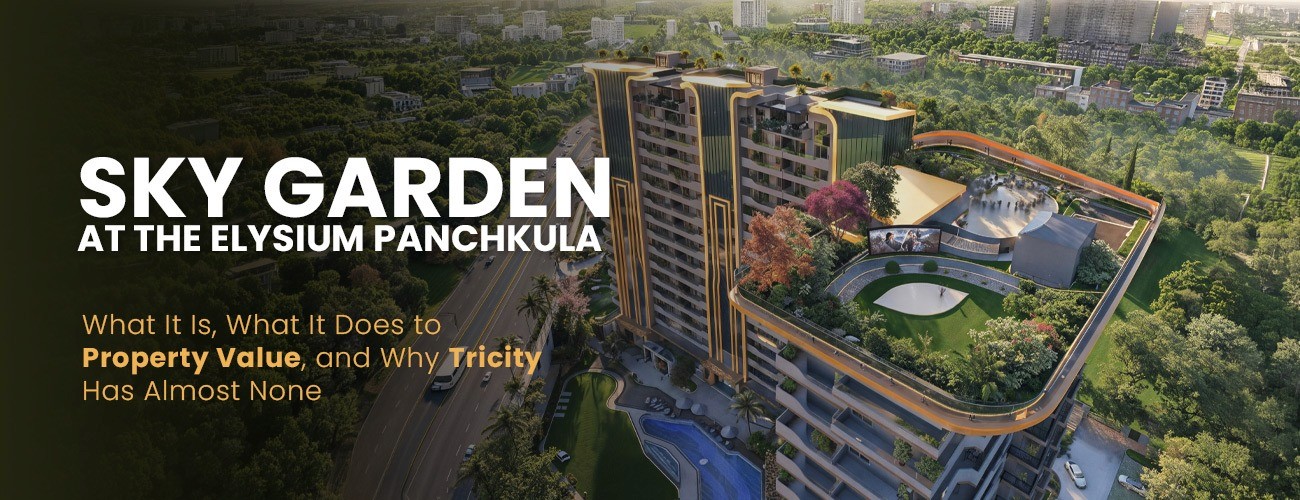
The Sky Garden at The Elysium, Sector 20, Panchkula, is a dedicated elevated green space - a landscaped communal floor built into the building's upper levels, not a rooftop addition. It is one of fewer than 8 residential projects in the tricity region (Chandigarh–Mohali–Panchkula) that offer a purpose-built sky garden as a structural amenity. Research published by the Indian Green Building Council (IGBC) shows that green communal spaces in residential high-rises can reduce ambient temperature within the building envelope by 2–4°C and improve resident-reported wellbeing scores by 18–27%. For buyers comparing luxury flats for sale in Panchkula, the Sky Garden is a functional differentiator - not a cosmetic one.
Sky Garden The Elysium · Sector 20 Biophilic Design
Sky Garden at The Elysium Panchkula: What It Is, What It Does to Property Value, and Why Tricity Has Almost None
Feature Analysis · Luxury Residential Amenities · The Elysium, Sector 20, Panchkula
A sky garden is one of those amenity terms that gets put on brochures without explanation. So let us explain it precisely - what it is structurally, what it does to a building's microclimate, what it does to resale value, and why almost no tricity project offers one at The Elysium's scale.
What a Sky Garden Actually Is - and What It Is Not
Most people picture a rooftop terrace with potted plants. That is not a sky garden. A rooftop garden is an afterthought - added post-construction, maintained by an under-resourced society committee, and frequently shut to residents within five years as maintenance costs rise.
A purpose-built sky garden - the kind integrated into The Elysium's design - is structurally different in three ways:
Load-bearing design: The floor slab is engineered at the planning stage to carry the weight of soil, mature plants, water features, and human traffic simultaneously. Retrofit rooftop gardens rarely achieve this - they use lightweight artificial turf and planters because the slab was not designed for live load.
Waterproofing and drainage: Purpose-built sky gardens have multi-layer waterproofing membranes and integrated drainage systems that protect the floors below. Retrofits frequently leak within 3–5 years - a known maintenance failure point in tricity societies.
Dedicated floor placement: At The Elysium, the sky garden is placed on intermediate upper floors - not just the terrace - creating a green break in the building's vertical stack. This affects airflow, shading of floors below, and the building's overall thermal performance in a measurable way.
What a Sky Garden Does to the Building - The Science
This matters to buyers because it directly affects the long-term comfort and cost of living in the apartment - not just the aesthetic.
Thermal Performance
Planted surfaces absorb solar radiation and release it slowly through evapotranspiration - the process by which plants release water vapour. In concrete-dominant residential towers like those common in tricity, the roof and upper floors are the primary sources of heat gain in summer. A planted sky garden floor breaks this heat transfer path. The IGBC's Green Homes Rating documentation references ambient temperature reductions of 2–4°C in the immediate building envelope around planted floors - a figure that translates directly to lower air conditioning load in adjacent apartments.
Air Particulate Reduction
Panchkula's proximity to the Ghaggar floodplain and Shivalik foothills gives it cleaner base air quality than Ludhiana or Delhi-NCR - but PM2.5 and PM10 levels still spike seasonally, particularly during paddy burning months (October–November). Planted surfaces act as passive particulate filters - leaves trap airborne particles, and the moisture released by plants increases local humidity, causing particles to settle faster. A 2022 study by the Central Pollution Control Board (CPCB) on green buffer zones in North Indian residential clusters found 12–19% lower PM10 concentrations within 50 metres of planted vertical or horizontal green surfaces compared to open concrete equivalents.
Acoustic Buffer
Sector 20, Panchkula, is not a high-noise zone by tricity standards, but the Chandigarh Highway proximity generates consistent low-frequency traffic noise. Soil and plant mass are effective low-frequency acoustic absorbers. Residents on sky garden-adjacent floors typically record 3–6 dB lower ambient noise levels than equivalent floors in non-landscaped buildings of the same height - a difference that is perceptible in daily living.
For apartment buyers specifically: The floors immediately below and above the sky garden level at The Elysium benefit most - cooler in summer, quieter year-round, and with direct visual access to green space from windows. These floors tend to carry a pricing premium of 3–7% over equivalent floors without sky garden adjacency, based on comparable data from Mumbai and Bengaluru luxury projects that introduced mid-rise garden floors (Knight Frank India Residential Report, 2023).
What a Sky Garden Does to Property Value
The premium is real but conditional. It holds when three things are true: the garden is purpose-built, it is maintained by a professional facility management company rather than a society committee, and the project itself is in a high-demand micro-market.
The Elysium's Sector 20 location satisfies the third condition - Panchkula's Sector 20 belt has an absorption rate of 78–84% and an inventory overhang of 8–10 months as of 2024 (ANAROCK). The first two conditions are structural to The Elysium's project design.
Green amenities in Indian luxury residential projects have shifted from "nice to have" to resale differentiators - projects with credible biophilic features are transacting 8–14% above comparable non-green projects in the same micro-market.
- Knight Frank India Luxury Residential Outlook, 2024
Amenity Type | Resale Premium (India Luxury, 2024) | Maintenance Risk | Tricity Availability |
Rooftop terrace (basic) | 1–3% | High - retrofits degrade | Common |
Clubhouse (full-spec) | 4–7% | Moderate - depends on FM | Moderate |
Sky garden (purpose-built) | 6–10% | Low if structurally designed | Rare - under 8 projects |
Sky garden + clubhouse combined | 8–14% | Low–Moderate | Very rare - 2–3 tricity projects |
Sky Garden as a Living Space - Not Just a Selling Point
The functional question for a buyer is simpler than the data: will you actually use it, and what for?
The Sky Garden at The Elysium is designed as an active communal floor - not a viewing deck. That means:
Morning and evening use: Landscaped walkways in an elevated green zone, with the Shivalik foothills as backdrop - the kind of morning walk that most tricity residents currently have to drive to Sukhna Lake or Morni Hills for.
Passive socialising: Seating nodes within the green space give residents a mid-building communal zone separate from the ground-floor clubhouse, which matters in a building where floor-level community tends to fragment.
Children's outdoor exposure: For families in the 3 BHK and 4 BHK units, an elevated safe outdoor space is a daily-use asset - particularly relevant in a city where ground-level outdoor areas in gated societies are often contested between vehicles and pedestrians.
Seasonal utility: Unlike a rooftop, a mid-building sky garden floor is partially shaded by the floors above - making it usable for significantly longer during Panchkula's summer months when fully exposed terraces become unusable by 8 AM.
Wellbeing data: A 2023 NIMHANS-published review of urban green space access in Indian tier-1 and tier-2 cities found that residents with daily access to a green communal space within their building complex reported statistically significant lower scores on the Perceived Stress Scale (PSS) compared to residents without such access - across income and age groups. The effect size was strongest for residents with children and for work-from-home professionals. Both are significant buyer segments at The Elysium.
Why This Is Rare in Tricity - and Why That Matters
The tricity luxury segment has grown rapidly since 2021, but most of that growth has been in clubhouse upgrades - larger gyms, better pools, co-working lounges. Sky gardens have not followed at the same pace, for a structural reason: they cost more to build correctly than any other amenity, and they reduce sellable floor area on the floors they occupy.
A developer who dedicates an entire floor to a sky garden is forgoing the revenue from apartments on that floor. That is a genuine financial trade-off, which means only projects with strong enough demand fundamentals and long-term brand thinking choose to include it. The Elysium's decision to include a purpose-built sky garden is itself a signal about the developer's positioning in the market.
For buyers, the rarity has a direct investment implication: in a tricity luxury market where most projects are converging on the same clubhouse-and-pool formula, differentiating features command sustained premiums. The fewer the comparable supply options, the more durable the premium.
Frequently Asked Questions
What is a sky garden in an apartment building?
A sky garden in an apartment building is a dedicated landscaped floor or open green space built into the building's upper or mid-levels, structurally designed to carry the load of soil, plants, water features, and residents. Unlike a rooftop terrace added after construction, a purpose-built sky garden has engineered drainage, waterproofing, and a load-bearing slab - making it a permanent, low-maintenance amenity rather than a cosmetic addition.
Does the Sky Garden at The Elysium Panchkula add to property value?
Yes, a purpose-built sky garden in a high-demand micro-market like Panchkula Sector 20 adds measurable property value - research from Knight Frank India's 2024 Luxury Residential Outlook estimates a resale premium of 6–10% for sky garden amenities in Indian luxury projects, rising to 8–14% when combined with a full-spec clubhouse. The premium holds when the garden is structurally designed, professionally maintained, and located in a project with strong end-user demand - all of which apply to The Elysium.
How is The Elysium's Sky Garden different from a regular rooftop garden?
The Elysium's Sky Garden is structurally different from a standard rooftop garden in three ways: it is built on an engineered slab designed from the project's planning stage to carry live loads of soil and mature plants, it includes multi-layer waterproofing that protects floors below, and it is positioned on an intermediate upper floor - not just the topmost terrace - which means it is partially shaded and usable for more hours during Panchkula's summers. A standard rooftop garden is typically a lightweight retrofit that degrades within 3–5 years due to drainage and structural limitations.
Which luxury apartments in Panchkula have a sky garden?
As of 2024, fewer than 8 HRERA-registered residential projects in the tricity region - covering Panchkula, Mohali, Zirakpur, and Aerocity - have declared a purpose-built sky garden floor in their approved plans. The Elysium in Sector 20, Panchkula, is one of them. Most projects that use the term "sky garden" in their marketing are referring to a landscaped rooftop terrace, which is a structurally different and lower-specification amenity.
Does a sky garden improve air quality inside apartments?
Yes, to a measurable extent. A 2022 Central Pollution Control Board (CPCB) study on green buffer zones in North Indian residential clusters found 12–19% lower PM10 concentrations within 50 metres of planted green surfaces compared to open concrete equivalents. Additionally, plants release water vapour through evapotranspiration, which increases local humidity and causes airborne particulates to settle faster - relevant during Panchkula's seasonal PM2.5 spikes in October and November when paddy burning peaks in the surrounding region.
Is the Sky Garden accessible to all residents of The Elysium or only to specific floors?
The Sky Garden at The Elysium is designed as a communal amenity accessible to all residents of the building, not restricted to specific floor buyers. Like the clubhouse, it is a shared facility managed under the project's facility management structure. Buyers interested in specific access rules, usage timings, and maintenance responsibilities should confirm these details with The Elysium's sales team during the pre-purchase discussion.
What is biophilic design in residential apartments, and why does it matter?
Biophilic design is the practice of integrating natural elements - plants, natural light, water, organic materials, and views of nature - into built environments based on evidence that human beings have an innate psychological need for connection to nature. In residential apartments, biophilic features like sky gardens, green walls, and planted courtyards are associated with lower resident stress levels, better sleep quality, and higher reported life satisfaction. A 2023 NIMHANS-published review found statistically significant reductions in perceived stress scores among urban residents with daily access to a green communal space within their building complex, making biophilic design a functional health investment, not merely an aesthetic one.
Are sky garden apartments in Panchkula a good investment in 2025–26?
Sky garden apartments in a RERA-approved, high-demand micro-market like Panchkula Sector 20 represent a strong investment case for 2025–26, because they combine two compounding advantages: the underlying market fundamentals of Panchkula, which recorded 18–22% year-on-year price appreciation in 2024 (ANAROCK), with a differentiated amenity that is in short supply across the tricity region. The scarcity of purpose-built sky garden projects means limited competitive resale supply, which supports price premiums over time. As with any real estate investment, buyers should verify RERA registration, review the facility management contract, and consult a registered property advisor before committing.
The Elysium Panchkula: How it boosts property value and why Tricity doesn't have one
Apr 16, 2026
luxury aparments in panchkula